Versión en español: Leer este post en español →
Why the world’s largest Indian motorcycle brand is dying in Mexico while thriving in Colombia
🔴 UPDATE: Did Hero wake up, or are these a drowning man’s last kicks?
Someone read the autopsy and didn’t like seeing themselves in the coffin. I received unofficial information about what would be the “rescue plan”:
The “India Command” in México: Hero is going to send its own supervisors directly to “Ensamblika’s” assembly lines. The diagnosis made here — good engine, second-rate assembly — apparently reached the people at the top. The problem, they say, is that in those plants they’re experts in 1980s technology: if the bike isn’t carbureted and can’t be fixed with a hammer and a generic CDI, the guys panic. Sending babysitters from New Delhi to oversee the electronics and ABS is their last resort to make sure motorcycles don’t leave the factory broken.
“Operation Don Chuy”: They’ve understood that the CESITs (Elektra’s service centers) are the graveyard of their reputation. The plan for 2026–2027 is to mass-certify independent workshops. Their way of saying: “We stay in Elektra to sell, but we’re getting out of their service centers to survive.”
Mexico as a springboard to the US: The strongest rumor is that Hero India sees Mexico as the launchpad into the United States market. If they can establish their own plant to export northward, local-market assembly would stop being a “favor” from Salinas and become 100% Hero-controlled.
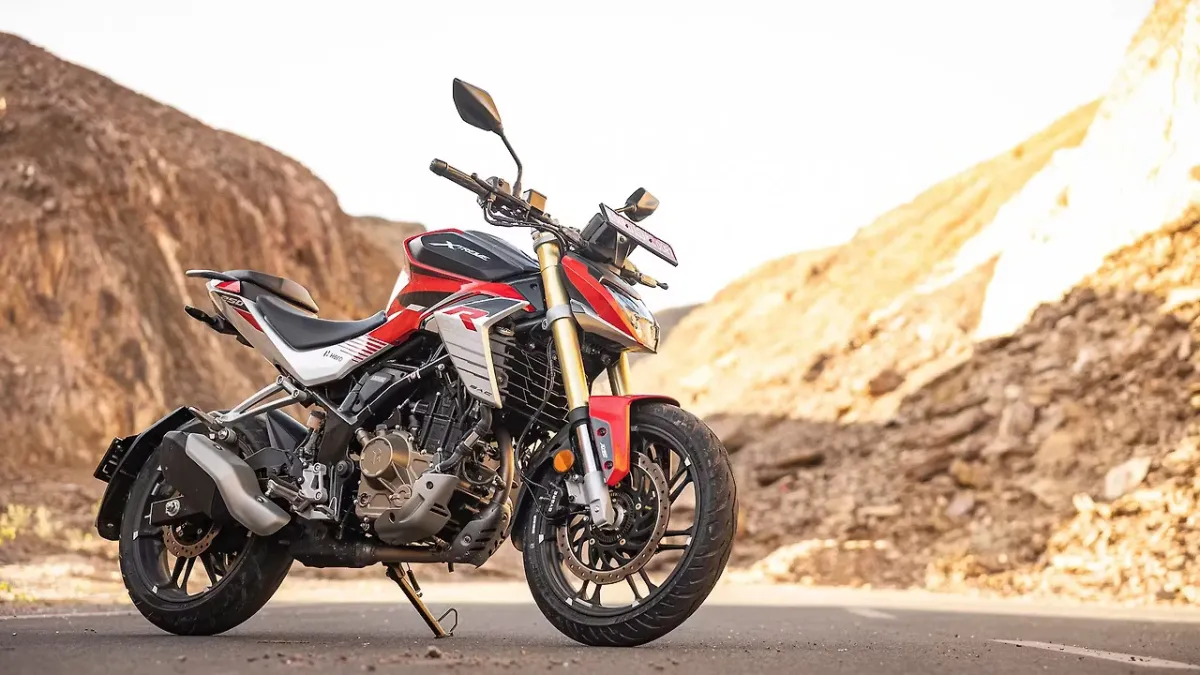
The Hunk 250R as a “palate cleanser”: And here’s what nobody is saying openly: the goal of the Hunk 250R is not to outsell Italika’s 250Z — that would be commercial suicide on price. The goal is to prove that Hero can actually deliver liquid cooling and technology that Italika hasn’t mastered at scale. It’s not a motorcycle to sell in volume; it’s a motorcycle to make the market stop seeing them as “almost Italika but more expensive.”
My counter-reply: All of that sounds very good in a Mumbai executive’s PowerPoint. But reality hits a wall at the Elektra counter and in the parts warehouse. If a part doesn’t arrive in under three days, no certified “Don Chuy” or Indian supervisor will save them from being forgotten.
The Numbers Don’t Lie
Hero MotoCorp arrived in Mexico in July 2021 with great fanfare. Grupo Salinas backed them, they promised to “revolutionize” the market, and they brought nine models. In August 2025, they celebrated having sold 100,000 motorcycles in four years.
That sounds impressive until you do the math:
100,000 bikes in 4 years = 25,000 bikes per year
For context: Italika sold 1,300,000 motorcycles in 2024 (with 1.5 million projected for 2025). Hero sells in Mexico what Italika sells in less than one month.
Hero’s market share: ~1.5% (25k out of ~1.6 million total market)
This isn’t growth. It’s crawling to survive.
The Catalog Collapse: From 9 Models to 4
Here’s the death signal nobody wants to see:
July 2021 (Launch):
- Xpulse 200
- Xpulse 200T
- Hunk 190R
- Hunk 160R (the bestseller)
- Hunk 150
- Eco 150 TR
- Eco 150 Cargo
- Ignitor 125
- Dash 125 (scooter)
February 2026 (NOW):
- ECO 150 MAX
- Xpulse 200 FI 4V
- Dash 125
- Hunk 250R (launched Sept 2025)
They eliminated 56% of their catalog. Including the Hunk 160R, which according to industry sources was their bestselling model.
This isn’t “portfolio optimization.” This is emergency amputation.
The Grupo Salinas Deal: The Shortcut That Became a Dead End
Here’s the secret few people know: Hero originally planned to enter Mexico independently in 2020–2021. They were going to invest in their own infrastructure, distribution network, and service centers. It was a major bet.
Then Grupo Salinas offered them a deal: “Don’t compete with us — join us.”
Hero accepted. And redirected all that planned investment to Colombia.
The result:
Colombia (real investment, own plant):  ~80,000 bikes/year
Mexico (via Grupo Salinas):             ~25,000 bikes/year
Colombia is triple the volume with half the population.
The Assembly Problem
Hero’s workshops in Mexico are the same as Italika’s. Hero has no infrastructure of its own. Grupo Salinas assembles Hero motorcycles using its Italika production lines.
The result, according to multiple independent YouTube reviews: bikes with a good engine (proven Indian design) but with assembly problems:
- Loose electrical connections
- Undertightened bolts
- Hydraulic system leaks
- Starting problems
Good engine + mediocre assembly = problematic motorcycle
And when the customer has a problem, where do they go? To the same Italika workshop that assembled it badly.
The Wrong Strategy From Day One
Hero made a fundamental mistake: they brought the wrong models.
What Mexico needed:
- Splendor FI 110cc at $20,000–22,000 pesos
- HF Deluxe FI 100cc at $18,000–20,000 pesos
- Passion FI 110cc at $24,000–26,000 pesos
Affordable fuel-injected motorcycles that could compete directly with Italika on price, but with better technology and fuel efficiency.
What they brought:
- Random models with no clear strategy
- Higher prices than Italika
- Only one premium bike (Xpulse) that doesn’t move volume
The result: Stuck in no man’s land. Too expensive to compete with Italika, without the brand prestige to compete with Honda or Yamaha.
Why Mexico Is “Impossible” for Hero
This is what Hero discovered too late:
1. Mexico has no emissions standards for motorcycles
In India, the Bharat Stage 6 standard (equivalent to Euro 6) has been mandatory since April 2020. It is prohibited to sell motorcycles with carburetors. That’s why all Indian motorcycles have fuel injection as standard.
In Mexico, the NOMs (Official Mexican Standards) exclude motorcycles from emissions regulation. They only regulate noise.
Without a mandatory FI requirement, manufacturers can legally sell 1980s technology. And they charge for it as a “premium feature” costing $9,000+ extra.
2. Italika’s absolute dominance
Italika doesn’t just dominate with 70% of the market. It has a closed ecosystem:
- Immediate financing through Elektra (no deep credit check)
- 900+ workshops across Mexico
- Established nationwide parts network
- Unbeatable prices
What Hero offers: an Indian brand nobody recognizes, at higher prices than Italika, using borrowed Italika infrastructure.
It has zero competitive advantage.
Colombia vs. Mexico: A Study in Contrasts
| Factor | Colombia | Mexico |
|---|---|---|
| Hero plant | Own | None |
| Quality control | Total | Depends on Salinas |
| Dominant competition | Moderate | Italika 70% |
| Emissions standards | Euro 3+ | None |
| Hero volume | ~80,000/year | ~25,000/year |
| Profitability | Positive | Negative |
| Future | Regional hub | Imminent exit |
Colombia isn’t just more successful. It’s three times more successful with less population.
Why? Because Hero controlled everything in Colombia. In Mexico, they depended on a partner with no real incentive to make them successful.
The Hunk 250R: The Last Desperate Attempt
In September 2025, Hero launched the Hunk 250R in Mexico:
- 249cc, 30 HP, liquid cooling
- 0–60 km/h in 3.2 seconds
- Dual-channel ABS
- Price: $69,999 pesos
On paper, it’s impressive. In practice, it’s a suicidal move:
- They eliminated the Hunk 160R (their bestseller) to launch this
- Absurd price: $70k when the Pulsar NS200 costs $55k
- Wrong segment: Nobody who buys Hero wants to spend $70k
- Same problem: Assembled by Italika
It’s like a restaurant on the verge of bankruptcy deciding to launch caviar instead of fixing its burgers.
Prediction: Hero Will Leave Mexico in 2027–2028
The signals are clear:
- Miserable sales (25k/year doesn’t justify continued operations)
- Collapsed catalog (56% of models discontinued)
- No real investment (everything routed through Salinas)
- Colombia is 3x more successful
Probable timeline:
- 2026: They evaluate whether the Grupo Salinas arrangement is still worth it
- 2027: Grupo Salinas: “Not worth it anymore — we’ll focus on Italika and Morbidelli. Chinese bikes make more money”
- 2028: End of Hero operations in Mexico
Exit cost for Grupo Salinas: ZERO
They don’t have to close workshops, let go of technicians, or dismantle anything. They just stop ordering Hero motorcycles from India. Cutting ties is almost too easy.
What If Hero Tries to Enter Directly After Salinas?
They already tried in 2020. They looked at the numbers. They preferred the Grupo Salinas shortcut.
Investment required for independent entry: $100–200 million USD
- Own distribution network
- Own service centers
- Parts inventory
- Aggressive marketing
- 3–5 years to break even
Probable result: 50,000–75,000 bikes/year (optimistic)
ROI: Negative for years
Likely corporate decision: “Mexico isn’t viable. Focus on Colombia.”
For Hero, Mexico will become what Cuba is for most brands: an impossible market.
Lessons for Other Brands
Shortcuts are expensive. Hero took the easy road with Grupo Salinas and paid with total loss of control.
Without emissions standards, technology doesn’t sell itself. FI is standard in India because regulation requires it. In Mexico it’s a “luxury” because there’s no law demanding it.
Market dominance is hard to break. Italika has a near-impossible lock-in: price + financing + network. Without all three, you can’t compete.
Quality control is non-negotiable. Good engine with bad assembly = destroyed brand.
Volume or death. 25,000 bikes/year doesn’t even cover operating costs. You need at minimum 100,000/year to be viable.
Conclusion
Hero MotoCorp is the world’s largest motorcycle manufacturer by volume. They sell 3+ million bikes per year globally. They dominate India. They’re growing in Colombia.
But in Mexico, after 4 years, they’ve barely sold what Italika sells in less than one month.
Not because Hero is a bad brand. It’s because they made every wrong strategic decision:
- Wrong partner (Grupo Salinas with no aligned incentives)
- Wrong models (no volume strategy)
- Wrong prices (too expensive to compete)
- Wrong assembly (compromised quality)
Colombia proved that Hero can succeed in Latin America when it does things right: real investment, total control, clear strategy.
Mexico proved that shortcuts don’t work.
By 2028, Hero will most likely be history in Mexico. And the lesson will remain: in dominated markets, either you enter seriously or you don’t enter at all.
Update: In February 2026, Hero Mexico has only 4 models in its catalog. Of the original 9, 5 have been discontinued. The countdown has begun.
What do you think? Can Hero turn things around, or is it too late?