Versión en español: Leer este post en español →
Querétaro is not where the party is. It’s the guy selling side salads outside the main taqueria.
Not a single match will be played here. Games are in Mexico City, Guadalajara, and Monterrey. What Querétaro gets is a national team that trains at La Loma, sleeps in Jurica, and goes to play somewhere else.
For that privilege, the local government already signed the FIFA Team Base Camp Host Agreement — including replacing the training field’s grass with natural turf to FIFA specifications: a million dollars minimum, paid by the local government. Plus road upgrades. Plus security. Plus aesthetics. All so the boxer can go fight in Guadalajara.
We’re the World Cup’s sparring partner. We pay for the gym and absorb the punches.
Below are the 12 patches the government is applying to make the film set look good in June. They’re in order. Read the ones that interest you, skip the ones you already know. At the end, if you make it, is the hit coming in August when the curtain falls.
🏟️ 0. The Stadium
March 2022. Querétaro vs. Atlas. The videos from that night went around the world: unconscious people, stripped and bloodied in the stands. Accredited sports journalists inside the stadium reported up to 17 dead in real time. The Querétaro government closed the day with zero fatalities, 26 injured, and zero arrests. The stadium closed for one year. Case closed.
Four years later, that same stadium in that same city will be Querétaro’s face to the world as a modern, safe city.
🚧 1. The Highway
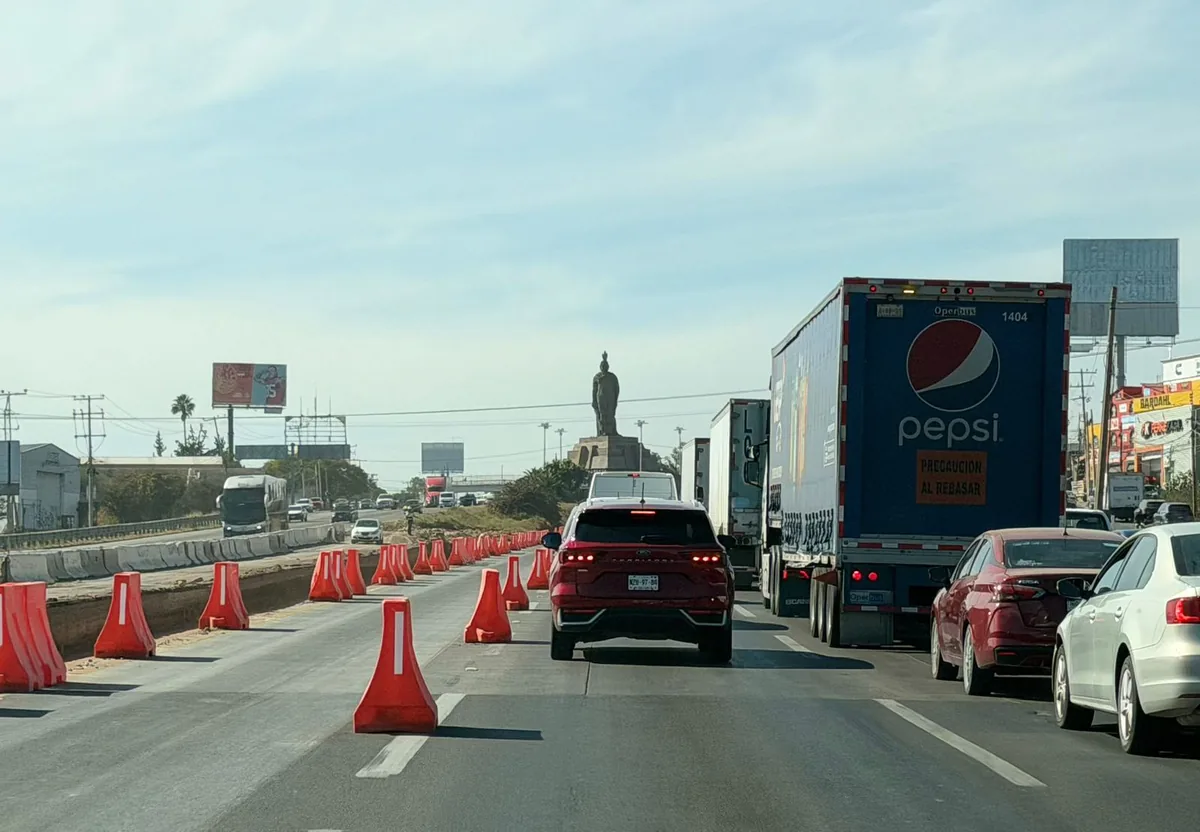
What they’re selling you: Expansion to 4 lanes on the El Colorado-Plaza de Toros stretch, ready by May 15. The “Bachetón” patching program handling the rest.
What it actually is: Event asphalt. They opened lanes without touching the storm drainage — June rains will turn that “fast lane” into a skating rink. The Bachetón is a band-aid, not hydraulic concrete; a semi-truck undoes it in weeks. And the 4 lanes will only succeed in getting traffic to collapse at Bernardo Quintana and 5 de Febrero faster.
The bottleneck didn’t disappear. They just moved it downstream.
📶 2. The Signal
The Belgian tourist uploads HD stories from the stadium. You’re still paying for some of the most expensive mobile spectrum in the world — up to 90% above the global average — for a signal that drops past Conín.
The difference is that during the World Cup there will be 5G connectivity bubbles at the Corregidora, VIP hotels, and the Historic Center. A one-month hotspot. When the FIFA delegation leaves, the good signal leaves with it. Your bill doesn’t go down.
How did we get here? Full breakdown: AMLO destroyed the IFT to benefit Slim →
🚁 3. Security
What they’re selling you: Plan Kukulkán. 20 drones, 3 helicopters, 600 National Guard troops on Highway 57. Harfuch promising “zero robberies.”
February 2026, while the drones are watching: The National Guard loses an officer kidnapped and killed in Huimilpan. His patrol truck is stolen with all its weapons. A drone records the crime in 4K. It doesn’t stop it.
In August, when the World Cup budget runs out, the drones go back in storage and Highway 57 goes back to being nobody’s territory. As always.
🗣️ 4. The English
500 “bilingual” police officers trained to assist international tourists. Wait for the procurement contracts when they come out: they’ll be 40-hour courses from some HR company connected to the municipality. The officer will know how to say turn left and no problem.
The first tourist who tries to file an actual police report will discover there isn’t a single public prosecutor’s office with a certified interpreter in the entire city.
What remains after the World Cup: the company’s contract. Not the officer, not the English.
✈️ 5. The Airports
This patch has three layers.
Layer one — the broken airspace:
The New Texcoco Airport was designed to be built next to the AICM. Two terminals on the same grounds, one system. Instead we have two airports separated by dozens of kilometers competing for the same sky.
Before AIFA, the AICM handled 61 slots per hour. Today it handles 44, because the Navy controls one and the Army controls the other, and neither military institution has any incentive to yield airspace to the other. Aircraft fly routes up to 80 nautical miles longer to route around AIFA.
In July 2025, an Aeromexico aircraft landed while a Delta aircraft was aborting its takeoff on the same AICM runway. The tower had authorized both maneuvers simultaneously. That’s today, with normal traffic, with controllers who have been warning about staff shortages since December 2024. The airspace redesign has safety flaws that will not be fixed before the World Cup.
Layer two — Celaya:
The AIQ is not an international hub. For long-haul flights, the region’s real option is the Bajío Airport in León. The problem: from León to Querétaro, without exception, you go through Celaya. Four consecutive years as the world’s most violent city, 109 homicides per 100,000 inhabitants.
When the National Guard arrived with Operativo Trueno in August 2024, homicides increased 222% the following month. Turn on the lights, the cockroaches hide. Send in soldiers with no territorial strategy: the cockroaches fight back.
Layer three — the tourist on public transit from AIFA:
There is no direct route. The trip is AIFA → bus to Mexico City’s Terminal Norte → wait for a connection → bus to Querétaro → Uber to the hotel. Realistic total time: 4 to 6 hours, no delays, assuming the Belgian tourist figures out where to buy a Primera Plus ticket.
The official solution is the AeroQ-Bus: 2 vehicles on the AIQ route, one per hour, in buses that AMEQ’s own director described as “low-end.” If the bus just left when you land, you wait 60 minutes on the curb with your bags.
Welcome to the World Cup.
🏥 6. The Hospitals
They’ll designate beds at IMSS and the Regional Hospital for “priority care for visitors.” On paper it’s an international event protocol.
In practice: if a Belgian shows up with appendicitis and you show up with a heart attack on the same day, the Belgian has an assigned bed and you wait.
The system was already at its limit before the World Cup. If you have anything that needs attention, take care of it before June 11 or after July 19.
⚡ 7. The Power
What they’re selling you: Uninterrupted broadcasts. Lit stadiums. Querétaro in global prime time.
What they don’t tell you: The CFE grid is at its limit. To guarantee power to the Corregidora and the training camps, someone pays the cost. That someone is your neighborhood, in the form of blackouts that the official press release will call “preventive maintenance.”
In June, with the heat, a 4-hour blackout isn’t an inconvenience. It’s a medical emergency for anyone with a family member dependent on equipment — or simply for anyone living in a city where 35°C is real.
The context nobody opens: AMLO spent years attacking Iberdrola publicly — plunder, foreign conquest, corrupt company. The ending: in April 2023 the Mexican government bought 13 power plants from Iberdrola for $6 billion dollars. 99% are combined-cycle gas plants, exactly the type of generation AMLO had protected by blocking renewables. Critics noted the government paid 40% above appraised value. Iberdrola cried in public, cashed the check in private, and left with pockets full of assets that would have lost value in the energy transition. Mexico was left with a gas-dependent grid with no reserve capacity. The performance was perfect for both sides.
Your neighborhood pays the bill when the lights go out in June.
💧 8. The Water
This is the one with the most silence around it and the one that will hurt the most.
The Valle de Querétaro aquifer has an official deficit of 63.7 million cubic meters per year according to CONAGUA: twice as much is extracted as is recharged. It has been classified as overexploited since 1997. Nearly 30 years of crisis that no government — of any party — resolved. The water table drops more than 2 meters per year. 60% of the metro area’s water already comes from overexploited aquifers, and the remaining 40% depends on Aqueduct II from Hidalgo.
No new water capture projects have been announced before June.
Now add tens of thousands of tourists in hotels — the highest per-guest water consumers in the system — plus irrigation for the freshly planted trees, plus the permanent cleaning operations FIFA requires.
The result: more aggressive rationing in working-class neighborhoods during the event, presented as “scheduled maintenance.” Go buy a 10,000-liter water tank. That’s not an exaggeration.
🚌 9. Transit
If they couldn’t implement a functional dedicated bus lane on Bernardo Quintana under normal conditions, they won’t be able to do it on Highway 57 during the World Cup. And if they do install one, you know what happens in Querétaro with dedicated lanes: the moment there’s a repair, everyone drives through wherever they can because there’s no enforcement.
The tourist who tries to get around on public transit will find overcrowded buses, drivers who don’t know where La Loma is, and zero real English signage.
And we already know the official solution: the AeroQ-Bus, 2 vehicles, one per hour.
🌳 10. The Trees
Non-native trees planted along the main road medians with no irrigation system. They just need to look green in the June photos. In the July heat they dry out. By then the World Cup is gone and nobody has a budget to water them.
In 2027 you’ll see the stumps on the same median where today’s official photo trees are standing.
🚶 11. The Cleanup
The pre-dawn sweeps that have already started don’t clean the problem — they relocate it. The homeless population from the Historic Center, the Corregidora access points, and the Highway 57 overpasses will show up concentrated in peripheral neighborhoods. No shelter is offered. They get moved.
Stray dogs get the same treatment from the same operations.
It’s the documented FIFA playbook from Brazil 2014 and Russia 2018: the city looks beautiful on camera, the periphery absorbs what the camera doesn’t show. When the World Cup leaves, the displaced return — or don’t return, because they’ve already been pushed further out.
The center will look like a European city on TV. What they removed from it will be in your neighborhood.
🌮 12. The Taco
The neighborhood markets and taco stands operate today with irregular slaughterhouse oversight, inconsistent cold chains, and suppliers without TIF certification. This isn’t news — it’s the normal state of things. Nobody says anything because “something didn’t agree with me” and that’s that.
During the World Cup, all available sanitary inspection capacity will concentrate where the cameras are: five-star hotels and FIFA camps. Neighborhood taco stands and markets will have even less oversight than they already do, because inspectors will be busy elsewhere and because nobody wants a vendor protest during the event.
The tourist eats “authentic,” films the taco for Reels, and leaves. You stay eating at the same places, with less oversight and a cold chain more stressed by the June heat.
It’s not anyone’s revenge. It’s meat without adequate refrigeration at 35°C. Biology has no political agenda.
What comes in August
Sheinbaum arrives at the World Cup with high approval ratings. During June, nationalism could push them to their peak. There are machines working, there are cameras, there is pride.
The hit comes later.
Potholes where the Highway 57 “expansion” was. Water rationing that doesn’t end. The CFE bill that doesn’t drop. The dried-out trees. The National Guard back in its barracks. And sometime in 2027, the Public Accounts report with the emergency contracts and direct awards nobody read in June because everyone was watching the game.
The pattern across all these patches is the same and has no political color: political agendas always come before the citizen. Celaya wasn’t fixed because it wasn’t convenient. Texcoco wasn’t built because it was the previous government’s project. Renewables weren’t invested in because it was more convenient to buy Iberdrola’s gas plants at a premium. The aquifer wasn’t resolved because water doesn’t generate headlines.
The same stadium where in 2022 the government closed the day with zero deaths while the videos showed something else will now be Querétaro’s face to the world as a safe, modern city.
The government didn’t fix the city for the World Cup. It built a film set.
You’re the stagehand who doesn’t have a ticket but does pay for the stage.
Citizen analysis from the wings. If any of this sounds like an exaggeration, save this post and read it again in August.
Sources: CONAGUA aquifer deficit 2020 · Celaya most violent city in the world 4 consecutive years (Consejo Ciudadano para la Seguridad Pública) · Operativo Trueno +222% homicides (SESNSP) · AICM from 61 to 44 slots/hour; Delta-Aeromexico incident July 2025 · AeroQ-Bus 2 vehicles, 1/hour (AMEQ Feb 2025) · AIFA-Querétaro 4-6 hours by public transit, no direct route · Iberdrola $6B USD 99% gas plants (Bloomberg/Expansión 2023) · Corregidora 2022: official version 26 injured, unofficial figures 15-17 fatalities (Récord, Azteca Deportes) · Team Base Camp Host Agreement FIFA: turf replacement ~$1M USD charged to host